Now through October 31, we're waiving application fees for all freshman and transfer applicants!
*Common app code: Central27
 Hunger and food insecurity affect thousands of individuals and families around the country every day. At CMU, as many as one in every three students may be experiencing hunger. The Student Food Pantry is here to support students who need a little extra help, so they can focus on their academic success.
The Student Food Pantry is located at 1200 S Washington St (Robinson Hall), Mt. Pleasant, MI 48858. The location is accessible via mobile device maps and includes on campus walking directions.
We are open weekly!
Summer Hours (Beginning May 11, 2026):
- Tuesday: 5:00 - 7:00 p.m.
- Wednesday: 1:00 - 3:00 p.m.
- Friday: 1:00 - 3:00 p.m.
Semester Hours (Resumes August 17, 2026):
- Monday: 12:00 - 3:00 p.m.
- Tuesday: 4:00 - 7:00 p.m.
- Wednesday: 2:00 - 5:00 p.m.
- Thursday: 2:00 - 5:00 p.m.
- Friday: 12 - 3:00 p.m.
If you are experiencing food insecurity, please create a profile on PantrySoft and fill out the Registration Form questions. The Student Food Pantry also offers care products (hygiene, cleaning, some kitchen, and school supplies).
First time visiting the Pantry? Stop in during our open hours and we'll help you get started -- no appointment or registration necessary.
Frequently asked questions
Where is the Pantry located?
The CMU Student Food Pantry is located under the Robinson Residential Restaurant near the North Campus Success Center. The address for the pantry is 1200 S Washington St (Robinson Hall), Mt Pleasant, MI 48858.
What are the requirements to receive support?
All currently enrolled CMU students are eligible to use the Student Food Pantry. There are no financial eligibility requirements. The Student Food Pantry is a resource for any student in need to use so they can focus on the things that really matter at CMU. Students frequently use the Pantry weekly to make ends meet, during breaks when they aren't working, if they were sick and missed a few days at work one week, and a variety of other reasons. If you could use some extra support in making your grocery dollars stretch, we hope you'll visit us.
Where can I find hygiene or cleaning products?
The Student Food Pantry offers a wide array of common hygiene products, cooking/food preparation utensils, cleaning products, and school supplies to meet your needs.
Are there other resources for students in need?
Several local non-profits are here to help students in need, including:
Clothing Inc.
Care Store
Financial Wellness Collaborative
Isabella County Restoration House
General Resource Assistance - dial 211
Salvation Army - Please call 989-773-4663
Max & Emily's, located downtown Mount Pleasant (125 E Broadway), is offering meals to people in need every day from 11:00 am- 2:00 pm. Please mention People Helping People (PHP).
More local resources can be found on our Food Resources document.
For students residing outside of the greater Mount Pleasant area, check out our Student Resources document.
Contact the Student Food Pantry in the Mary Ellen Brandell Volunteer Center at 989-774-7685 or via email at foodpantry@cmich.edu for assistance connecting to any other needs.
How can I refer a student to the Student Food Pantry?
Please complete the referral form on the Student Food Pantry Engage Central page and we'll reach out directly to the student with information about resources available at CMU and in the community. Thank you for supporting CMU students.
How can I support the Student Food Pantry?
Food and care item donations for the Student Food Pantry can be dropped off at the Mary Ellen Brandell Volunteer Center, located in the Bovee University Center, room 106. Please see the list of donation needs linked below and on the CMU Student Food Pantry Engage Portal.
Monetary donations in support of the Pantry can be made on our Fund CMU page.
What if I am not a student?
Several local non-profits support he local community's needs, including:
Isabella County Restoration House
Isabella Community Soup Kitchen
United Way General Assistance - Dial 211
Salvation Army - Please call 989-773-4663
STI Testing and Health Resources
Central Michigan District Health Department
CMDHD provides the most affordable STI testing services and health care in the Mt. Pleasant area.
Health and Wellness
Students in need of health care can find resources at CMU Student Health Services. On-campus clinics are staffed with board-certified health care professionals who can provide the treatment you need. Our staff can also work hand-in-hand with your family doctor or specialist to manage ongoing treatments and services while you are attending CMU.
The Student Food Pantry encourages students to know their status and get tested once a year (or between partners) to help stop the spread of sexually transmitted infections.
Please call the Mary Ellen Brandell Volunteer Center at 989-774-7685 or email foodpantry@cmich.edu with any other questions.
Trip leaders turn service into memories
by
Eric Baerren
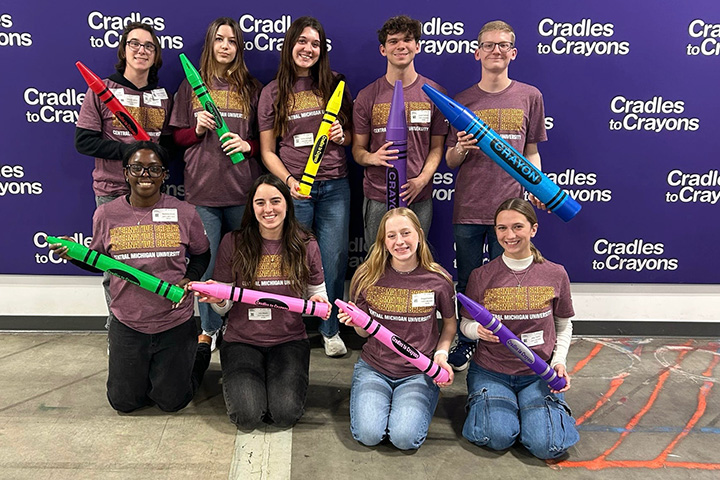
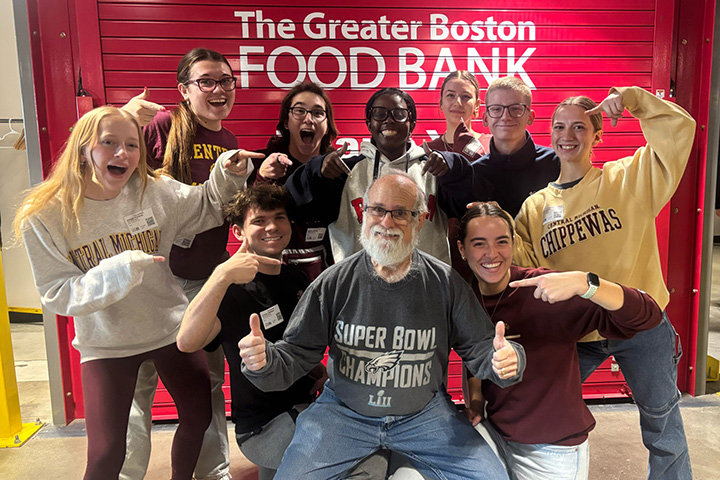
A group of Central Michigan University students bonded while volunteering for two organizations during an Alternative Breaks trip to Boston.
Nine students packed food for a Boston food pantry and organized clothing for a community outreach organization traveled for a week in December.
Grace Curtis, a psychology major and dance and childhood development minor, led the weeklong trip in December with Julia Moore, a double major in law and economics and communication, a minor in legal studies.
“We spent two days in the Greater Boston Food Pantry and the other two days in Cradles to Crayons,” Moore said. “We got to pack meal boxes on the first day at Greater Boston Food Pantry and then packed boxes for senior citizens on the second day.”
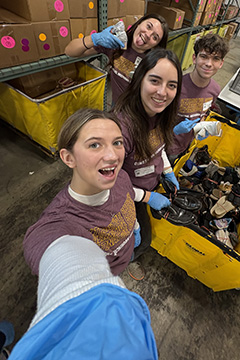
At Cradles to Crayons, the students cleaned and sorted donated clothing and footwear. The work helped them understand how to take items that arrived in bulk and separate them for people who needed them.
“You see some interesting things while sorting clothes by size one day or cleaning shoes to make them as brand new as possible,” Curtis said. “We did this every day and got better at what we were doing because we knew what they were looking for in the next step.”
Along with organizing clothes and shoes at Cradles to Crayons, volunteers also went shopping in the warehouse for different orders submitted by an advocate or sponsor of the child, such as school staff or another adult. Kids would then receive their specific order, like a pair of size 12 kids’ boots, from their advocate.
“It was free for their kids,” Moore said. “Cradles to Crayon’s goal is that every time a kid gets an order, they have enough clothes to make it through a week of play, school and sleeping.
In addition to volunteering, Alternative Breaks has a community immersion aspect, meaning they get to engage with the community they’re helping serve, essentially.
“We went to the Harvard Museum of Natural History which was really cool,” Moore said. “We also went to the Snowport Holiday Market which was really awesome because it was all like local craft vendors.”
“We visited local Boston businesses and walked around downtown in the city,” Curtis said.
A big part of an alternative trip is forming bonds with the other students.
“We played lots of card games at the hotel, like SkipBo and made food almost every night,” Moore said. “It’s a big part of alternative breaks, you bond a lot when you’re all sleeping in the same room, cooking together, spending time in the same car and other activities,” Curtis said.
“Aiden would run every night and Grace and I would sit in the gym and bounce on yoga balls,” Moore said. “There has to be a site leader with a participant always, then they’re running.”
One of the most rewarding things about leading a trip is getting a glimpse into how community partner agencies benefit the communities they serve, Curtis said.
“There’s so much that goes into them,” Curtis said. “Being able to see a little sneak peek into a small part of their operation is incredible and learning about the communities they're helping.”
Moore loves watching the participants grow from the very first weekly meeting to the very last day they’re doing service, especially if it’s a participant’s last break.
“We always say, think back to where you were when you first came on an AB to where you are now,” Moore said. “Watching people go through that process and fall in love with the program that I love is so rewarding for me.”
This was the second time Moore and Curtis led a trip.
Both students continue to return as they can immerse themselves in different communities, even during a short period of time.
“We see so many different perspectives and communities,” Moore said. “I care about issues that I never would have even acknowledged before if I were not a part of alternative breaks. Bringing all those different perspectives and experiences, you can apply those skills to almost anything you want to do.”
Curtis loved learning about each person she met and will continue to build her social skills through traveling with alternative breaks in the future.
“Alternative Breaks is an awesome way to be around people, no matter what their background or experience is. I love getting to know and working with them,” she said. “Alternative Breaks quickly makes you a people person.”